

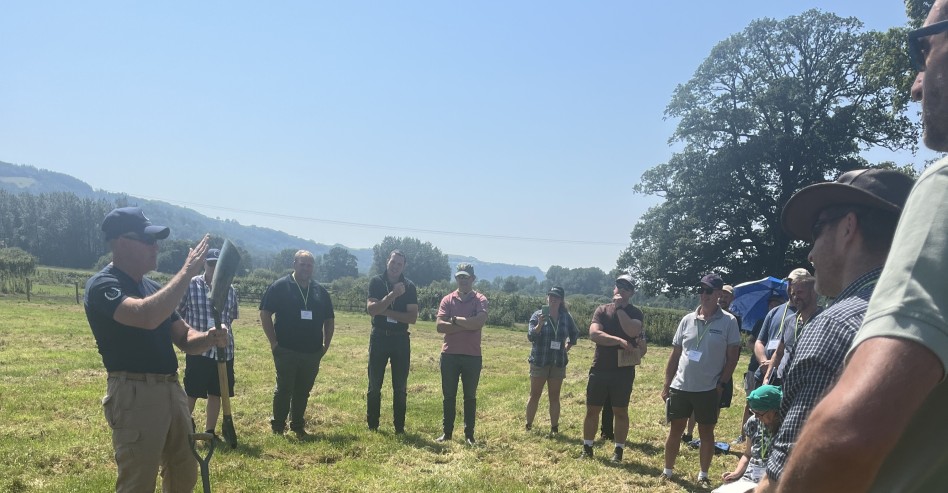
Regenerative farming expert Dr Allen Williams recently crossed the Atlantic Ocean to share his extensive knowledge of soil health, pasture-fed beef and adaptive grazing systems with farmers in Wales. Among those attending the event was young farmer and NFFN member Rhiannon Davies, who shares her reflections on learning from one of regen ag’s leading voices.
As farmers, we often cite a lack of profit as a reason to avoid diving deep into regenerative practices. Allen addressed this immediately, clarifying that his primary focus is helping farms thrive both financially and in terms of production. This was music to the audience's ears, given the significant financial challenges we face due to climate change and political shifts. Allen reminded us that our ability to observe is our most important tool; it builds intuition, which leads to the knowledge essential for progress.
One particularly striking point from the workshop was the assertion that "we are the most undernourished and overfed population in human history." Allen proposed regenerative agriculture as the solution, allowing us to work in synchrony with nature. Hearing this delivered so directly was both eye-opening and inspiring.
Allen outlined three core rules for adaptive grazing and stewardship. First is the Rule of Compounding, which states there are no neutral effects - only positive or negative ones. Second is the Rule of Diversity, which stands against monoculture and encourages us to experiment boldly. Finally, the Rule of Disruption involves strategically changing routines. Using the metaphor of physical exercise, Allen explained that by varying our routines, our soil and land can grow healthier and stronger.
My personal highlight of the day was learning about soil aggregation and its central role in soil health and crop growth. This was a new subject for me, and Allen explained the scientific detail exceptionally well. I look forward to applying this knowledge on the farm and throughout my continued education as a young person involved in farming.