Voices from the Fields

Scared ****less… but doing it anyway: My journey into regenerative farming

Scotland
United Kingdom
Mental health
agroecology
regenerative farming
whole farm approach

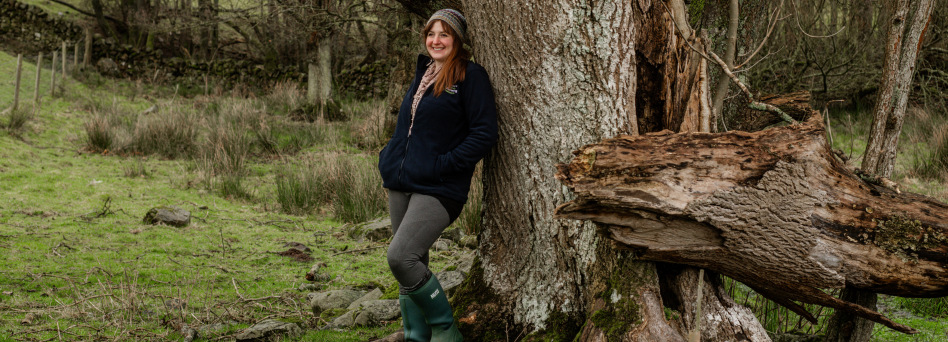
In the last year alone, farmers across the UK have had to deal with wildly fluctuating commodity prices, erratic and extreme weather events, and unwelcome news from governments. As farmers grapple to maintain viable businesses in an ever-changing landscape, NFFN farmer Ruth Ashton-Shaw from Low Auldgirth Steading in Dumfries and Galloway shares the psychological impact these challenges can have.

It was a typical Wednesday in January. The weather was doing its best to convince me the world might just end in mud. I’d just emptied the last bag of sheep feed into the trough, the hay shed was nearly bare, and my phone buzzed with a bank balance alert that made me feel physically ill. Even though it was nearing midday, the light had barely lifted the gloom, and the landscape outside looked more like churned sludge than the fields they were supposed to be.

I stood in the sheep shed, motionless, watching the pregnant ewes calmly chewing the cud. They were oblivious - warm, dry, full-bellied. But I wasn’t. I was utterly exhausted. Lambing was three weeks away, the worst of winter was still to come, and spring felt like a fantasy. In that moment, I felt totally alone. The pressure was inescapable, and the cracks were beginning to show.

This could have been any farm, on any winter’s day, anywhere in the UK. But in that moment, it was just me, in a cold shed, realising that I might not be able to keep going.

I’d come into farming late and naïvely - with an urban background, a romantic notion of rural life, and no concept of just how steep the learning curve would be. I’d once lived in a world of weekends off, regular paydays, and manageable expectations. Farming blew all that apart. Its relentless cycles and hard life lessons humbled me fast. It could be breathtaking and soul-destroying all in the same day. Yet despite the challenges, I loved it. There’s an indescribable joy in working outdoors on the land, being part of a movement that’s spanned continents and generations. Growing my own food gave me an enormous sense of empowerment. I felt like I had a purpose here.

I tried to get into the game, but I was a small-scale newcomer with a few ‘novelty’ breeds - I just couldn’t compete. Land prices were rising as I was sinking into debt. I was clearly not cut out for this game. God knows I tried.

Ruth Ashton-Shaw

I was lucky in many ways. Welcomed by my neighbours - local farmers, born and bred in these parts with farming firmly gritted under their fingernails and in their bones. I was never alone, never short of a word of advice, a loan of equipment, or a helping hand that could easily be reciprocated. I found myself becoming part of a community (something you just don’t get in the hustle of the city), a network of suppliers, contractors, machinery, markets, and favours. We were all in it together. No two farms were the same, but no one was left out. Behind that camaraderie, though, a deep unspoken shadow hung over me: how long could I keep this up?

The industry ethos was clear: scale up, focus on productivity, finish faster, push harder, produce more. Go big or get out. Subsidies and schemes encouraged that mindset. I tried to get into the game, but I was a small-scale newcomer with a few ‘novelty’ breeds - I just couldn’t compete. Land prices were rising as I was sinking into debt. I was clearly not cut out for this game. God knows I tried. But in the winter of 2019, it was clear that this wasn’t a game I was ever going to win. As a first-generation farmer, I had no inherited knowledge, no safety net, and no one to call when it all fell apart. The farm was bleeding me dry - emotionally, physically, financially. I was chasing a version of farming that didn’t want me. I was broke. And I was burnt out. This was my rock bottom. Something had to change.

Here’s the thing about farm businesses - they’re never just a business. They’re everything. They’re your job, your home, your lifestyle, your identity. You walk the fields every day and learn where the wind bites, where the sheep shelter in a snowstorm, where the grass always grows first in spring. You become as hefted to the land as your flock. So when the farm starts to fail, it’s not just your job at stake - it’s your whole life. Stepping away would mean losing the roof over my head, the animals I’d raised, the land and the lifestyle I knew, and the community I was part of. It wasn’t just pride at stake here - it was my life.

Even with the feeling that I had nothing left to lose, I still had everything to lose.

That’s when I first heard the phrase regenerative agriculture. It hadn’t yet become the buzzword it is today - just a passing comment in an article I stumbled across. But it piqued my interest. I spent the next month falling down a rabbit hole of soil science, pasture management, biodiversity, and natural cycles. It felt like a completely different approach to where I had been. Focusing from the bottom up, working with the entire ecosystem - it just seemed to make sense. It promised better soil, healthier animals, reduced inputs - and crucially, it didn’t require huge financial investment.

Between the influx of cash from selling stock and the relief of not having to buy in so many inputs, I suddenly found myself feeling a little lighter. The financial worry lifted, and I realised how much dread I’d been living with.

Ruth Ashton-Shaw

It sounded almost too good to be true, and when I explained my new ideas to my long-suffering mentor, he rolled his eyes. “If it was that easy, we’d all be doing it.” And he had a point. The industry is full of silver bullet promises, always sold in a bottle, a bag, or a bank loan. But this… this was different. No one was trying to sell me anything. It felt less like a product and more like a shift in perspective. Despite the doubt and uncertainty, I decided to trust my gut and give this regenerative thing a shot.

There was no helpful handbook. No magic button to press. I just started where I was, alone in a barn in the depths of winter. And so, with my livelihood at stake, I stepped into the unknown.

My first decision was a brutal one: to halve the amount of stock the farm was carrying. The problems, the poor doers, the escape artists would have to go. It was a risky move - less stock meant less income, and once they were gone, they were gone. But between the influx of cash from selling stock and the relief of not having to buy in so many inputs, I suddenly found myself feeling a little lighter. The financial worry lifted, and I realised how much dread I’d been living with. Dread to look at the sheep, to find what new problem the day would bring, dread to check the fields, dread to look at my bank balance. I felt free - and able to think.

However, with the relief came changes. The first I noticed was the eerie silence. I’d fallen off the radar. No more calls from sales reps, no more nods of agreement in the feed store or sympathy in the pharmacy, no more mirroring the actions of neighbouring farms. It was isolating. Without the constant hum of “shoulds” and “musts,” I realised how little of my previous approach had been based on my own observation or decision-making, and how much was just going with the flow.

Eventually, spring arrived, as it always does, and with it came grass. But not just grass - life. A relief from grazing pressure brought wildflowers I hadn’t seen before. Insects. Birds. The place began to sing again. Something inside me started to thaw.

It was the scariest step I’ve ever taken - letting go of the way things “should” be and trusting something I didn’t yet fully understand. But I’m glad I was scared. I’m glad I had nothing left to lose. Because that’s what made me brave enough to try.

Ruth Ashton-Shaw

I was still farming, but now I was learning how to farm. Not just reacting to (usually bad) situations, but listening: to the land, the weather, the animals, the seasons. Problems became clues, not crises. Work became more thoughtful, less relentless. I was making fewer mistakes - because I was actually understanding what I was doing.

And I realised I wasn’t alone.

As I stepped further into this way of working, I began to find others on a similar path - farmers quietly challenging the status quo and rebuilding their systems from the soil up. I discovered the Nature Friendly Farming Network. Through farm walks, events, and informal meet-ups, I began to connect with people from every corner of the sector - those just starting out, and those who’ve been doing this for decades. Different backgrounds, different motivations, but all arriving at the same place: we can farm better.

There was - and is - a real sense of camaraderie. Knowledge is shared freely. Mistakes are admitted without shame. And through that, we’re not only supporting each other - we’re shaping policy, influencing change, and helping to make this kind of farming a viable, supported option for others. There’s strength in that. A feeling of momentum. And a lot of hope.

What started as a last-ditch attempt to save an insignificantly small farm in the corner of Scotland has grown into something much bigger than me. Because working with nature doesn’t just benefit my business - it’s created a knock-on effect I never could have anticipated. Wildlife has returned in abundance. I see new species all the time. Ponds are brimming with life. Birds I didn’t know the names of now nest in our hedges. And the joy that brings isn’t mine alone. My neighbours’ gardens back onto our fields. Children come to the fence to watch the lambs and learn the names of the birds. People stop to ask questions. 

The energy is infectious. The positivity spreads.

And that’s the truth at the heart of this journey: regeneration doesn’t just happen in the soil. It happens in us. In our communities. In our industries. In our way of seeing the world and our place in it.

It was the scariest step I’ve ever taken - letting go of the way things “should” be and trusting something I didn’t yet fully understand. But I’m glad I was scared. I’m glad I had nothing left to lose. Because that’s what made me brave enough to try.

And now, in this wild, beautiful corner of Scotland, I feel like I’ve found my way home. A home where I am happy, where I can thrive. A home I share with nature and livestock.

A home where I belong.

Cookie consent

We use cookies on this website to improve your experience, provide social media features, and analyse our traffic. By clicking Accept All, you agree to the use of cookies as outlined in our Cookie & Privacy Policy. You can manage your cookie preferences at any time by clicking Cookie Settings.