

Resources

Why soil holds the key to managing water on farms

United Kingdom
Farm Practices
Water
Soil
soil health

We need to change the way we think about water on farms - here’s one NFFN farmer’s advice on how to do that.

For NFFN Scotland Steering Group Member Ian Davis, the way we think about water on UK farms is unhelpful and leaves farmers extremely vulnerable to climate change.

Here, he explains how his view of water shifted, and what he tells farmers when he now advises them about water management.

The basics - why do we need a mindset shift on water?

Ian is frank in his belief that UK agriculture as a whole has “a massive attitude problem” when it comes to the subject of water and its role in farming. This can be summed up as seeing water as something that always needs action to deal with.

“Too often you will hear the grumbles that ‘it’s too wet to get on the land’ followed by comments such as ‘we could really do with some rain now’ only a few weeks apart. It’s indicative of a mindset that sees water as a problem,” Ian says.

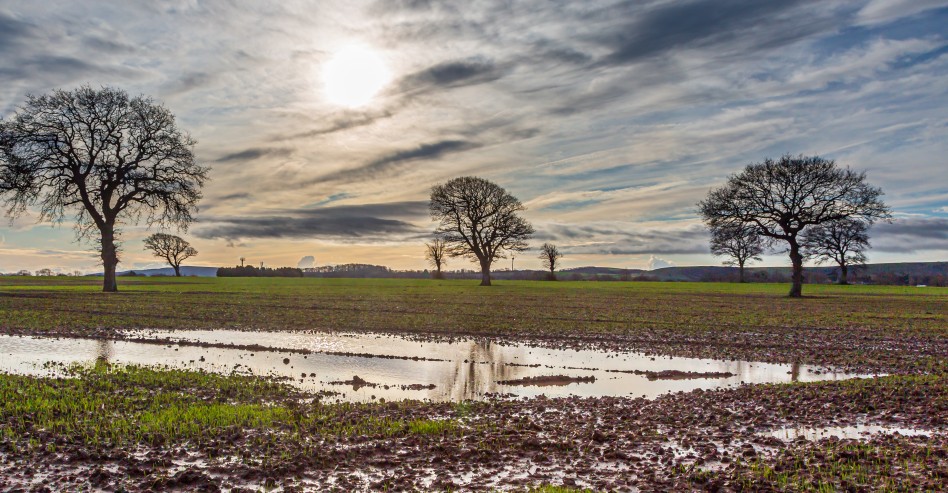
Historically, artificial drainage has removed water from farmland as quickly as possible when it rains, rather than storing it for use during dry periods. With climate change bringing more extreme rainfall events and longer spells of drought, it is time for a rethink.

What is a nature-friendly approach to water management?

Shifting from conventional to nature-friendly thinking about water management involves, for Ian, moving away from “boom and bust” cycles of having too much and too little water to working out how it can be managed as a resource for a farm.

This means maximising the amount of water held on a farm, either in the soil or in reservoirs, ponds or other bodies of water.

It is also possible to hold more water in landscape features such as boggy areas of the farm or planted swales.

I can guarantee that driving around in autumn, I’ll see lots of bare, open ground. This is fundamentally bad for soil health. You just will not get the microbial and fungal richness needed for soil to hold water well.

Ian Davis

For some farmers, more radical approaches to water management may be possible. These include reintroducing beavers, which act as ecosystem engineers and create pools and wetland habitat, or changing the crops on an arable farm for ones requiring less water.

How did Ian change his approach to water management?

Ian spent 23 years of his career farming in Hertfordshire while also managing 650 miles of watercourses for the National Rivers Authority. However, it wasn’t until 2017, when Ian spent a month in New Zealand and saw the impact of regenerative agriculture, that he began to think seriously about practical changes at home. With only a few small ponds and ditches on his 188-acre farm, Ian knew that boosting soil health was the route to holding water better.

“Using soil for water management solves both ends of the conundrum at once,” Ian says. “Healthy soil soaks up the rainfall quickly, before storing it for plants to use during dry periods.”

Ian’s enthusiasm extended to major cropping changes, with arable cereals gradually being phased out in favour of his grass-fed suckler beef system. He introduced rotational grazing, with long rest periods tackling compaction. Over several years, this led to improvements in water infiltration rates and the soil’s water-holding capacity.

What are Ian’s top tips to improve water management?

Ian knows his drastic changes are unrealistic for many farmers. However, water management can be improved without wholesale transformation.

Ian advises planting cover crops to ensure soil is never left bare. “I can guarantee that driving around in autumn, I’ll see lots of bare, open ground,” he says. “This is fundamentally bad for soil health. You just will not get the microbial and fungal richness needed for soil to hold water well, because there’s nothing there to feed it. Arable cover cropping is absolutely essential.”

Improving water management through soil health also means adopting other pillars of regenerative agriculture, such as increasing diversity in cropping. For arable farmers, Ian suggests varying crops in alternating strips, rather than a huge, monocultural block. For livestock farmers, this means diverse swards with grasses and wildflowers encouraged through planting or allowing natural seed banks to regenerate.

We are now seeing extremes of weather that our parents and grandparents never saw. We have to ask ourselves how robust our business and growing model is, and we have to adapt.

Ian Davis

Wetter areas of the farm should, wherever possible, be taken out of food production and managed for nature. This avoids the costs, both financial and environmental, of using excessive amounts of inputs to grow crops on unsuitable land. It also ensures land suited to holding water performs this function.

What are the problems with this approach to water management?

Some of Ian’s suggestions, such as cover cropping, can be expensive. He suggests that, where permitted, leaving cover crops on some parts of the soil all the way through to summer and then harvesting the seeds for use the following year could reduce cost. He also says the broader industry has a role to play, as farmers in New Zealand and Australia pay far less for cover crop seed in recognition of its importance.

Another issue is patience, as the results of improving soil health will not be immediately obvious, and may take several years to be fully achieved.

Conclusion

With climate change here and set to get worse, this is something no farmer can afford to avoid considering.

“We are now seeing extremes of weather that our parents and grandparents never saw, and they are coming quite frequently,” Ian says. “We are moving from crops being ploughed back into the soil because fields were too wet to harvest, to irrigation licenses being suspended as watercourses reach critically low levels.

“We have to ask ourselves how robust our business and growing model is, and we have to adapt.”

Cookie consent

We use cookies on this website to improve your experience, provide social media features, and analyse our traffic. By clicking Accept All, you agree to the use of cookies as outlined in our Cookie & Privacy Policy. You can manage your cookie preferences at any time by clicking Cookie Settings.