
Resources

Putting IPM into practice in a Northern Irish market garden

Northern Ireland
Farm Practices
fruit and vegetables
horticulture
Integrated Pest Management
IPM
Market garden
pesticide reduction

Growing veg to organic principles means Chris Dobbs uses a range of alternatives to chemicals to deal with pests.

Chris’ Market Garden is a one-acre horticulture operation in County Antrim, run by NFFN Northern Ireland steering group member Chris Dobbs.

Chris grows a variety of vegetables and salad crops using organic principles. This means he uses no chemical pesticides, so Integrated Pest Management (IPM) techniques are an essential part of his work. 

How does Chris use IPM?

For Chris, IPM is largely a preventative approach, as chemical-free farming offers growers fewer tools once pests have already overrun cropland.

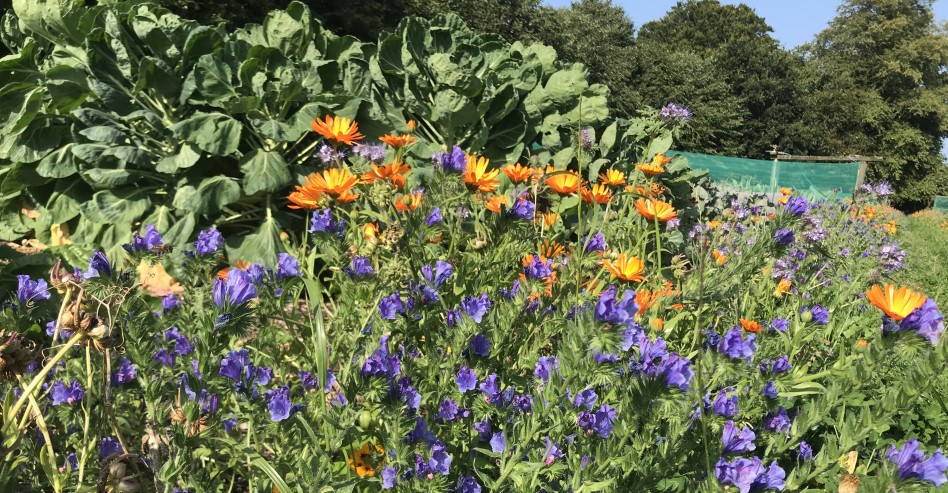
To protect his crops from pests, Chris employs a variety of nature-based solutions. Around his growing beds, he plants a species-rich mixture of annual and perennial flowering plants. Some of these provide a food source for slugs and caterpillars, which draws them away from his vegetables and salad. Other plants, like marigolds, give off a scent that confuses insects looking for crops such as carrots. 

Plants such as achillea and Queen Anne’s Lace attract predatory insects such as ladybirds and parasitic wasps. The ladybirds eat aphids, while the parasitic wasps lay eggs in the larvae of caterpillars, with the young wasps then feeding on them. Chris encourages wasps in the market garden, as caterpillars are also a food source for them. 

Using IPM influences Chris’ crop choices. He now grows baby salad leaves rather than larger lettuces, as these are generally harvested before pests can become a problem.

Chris also uses natural pest control techniques such as the naturally occurring bacterium Bacillus thuringiensis.  “It’s actually quite gruesome,” Chris says, “You spray the bacteria on the leaves and it activates inside the caterpillars upon ingesting, so their digestive system gets blocked up, a kind of terminal indigestion.”

However, some pests such as cabbage and carrot rootflies have no nature-based solutions available. To deal with this, Chris resorts to an old-fashioned, low-tech approach and puts netting over the vulnerable crops, weighing them down with sandbags. 

“The netting is vital for protecting carrots and turnips from rootflies which live on the ground,” Chris says. “They are quite a big investment, so you need to ensure they don’t rip or get weeds tangled up in them. Ideally, you want them to last five to 10 years.” Chris says farmers and growers also need to check what is going on underneath the nets, as they can trap pests inside as well as blocking them out.

What challenges has Chris experienced?

As he is growing his business and expanding his customer base, quality control is an important consideration for Chris. “Most people don’t grow their own food anymore and everything in the supermarket is graded so it looks perfect,” he says. “You will struggle to sell veg that has a big hole in it, or salad bags that have a slug or a caterpillar in them.” 

Using IPM also influences Chris’ crop choices. He now grows baby salad leaves rather than larger lettuces, as these are generally harvested before pests can become a problem. Crop rotation also helps reduce problems with pests; a well-thought-out crop plan ensures that crops that are susceptible to the same pests do not follow each other in the same location.  

He recommends that growers are mindful of accidentally creating habitat for pests. “If you leave a tarpaulin down for any length of time, you create the perfect habitat for slugs. It’s the same with crop netting left heaped in the corner of a field - when you roll it out again, you may be spreading slugs over your newly transplanted seedlings.”

Finally, Chris notes that healthy, well-nourished crops are less attractive to pests. 

Cookie consent

We use cookies on this website to improve your experience, provide social media features, and analyse our traffic. By clicking Accept All, you agree to the use of cookies as outlined in our Cookie & Privacy Policy. You can manage your cookie preferences at any time by clicking Cookie Settings.