
Discussions on nature-friendly farming took place at a crucial point for reform.
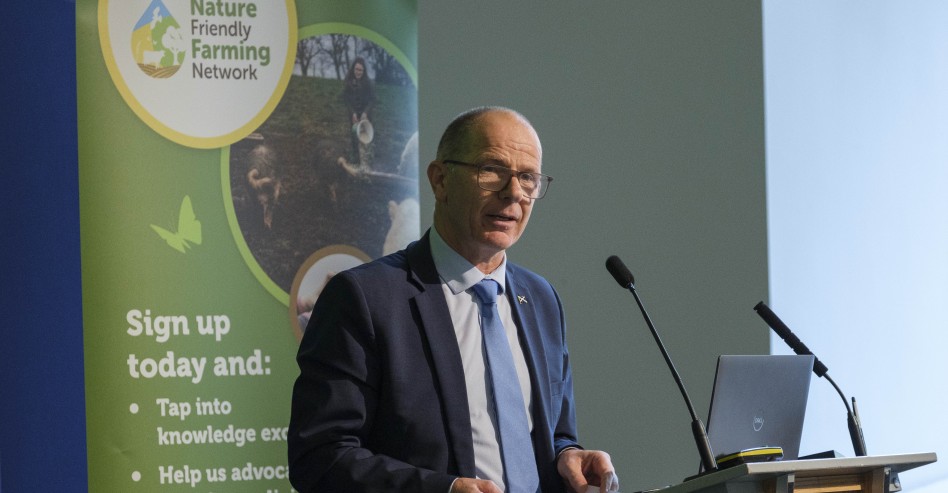
NFFN Scotland held a frank meeting with agriculture minister Jim Fairlie to discuss our concerns about how the Agricultural Reform Programme (ARP) has developed over the past four years and what the new budget and forthcoming election could mean for its direction.
NFFN Scotland, alongside steering group chairs and farmers Denise Walton and Ruth Ashton-Shaw, met the SNP politician at Holyrood early January to set out the key requirements for the ambitious transition outlined by the Government in the Agriculture & Rural Communities (Scotland) Bill, passed in 2024. This transition must deliver a nature-friendly future for farming and farm businesses across Scotland, in order to meet the demands of the nature and climate crises.
This is a crucial moment for Scottish farming policy, as the future framework for supporting the country’s agricultural industry begins to take shape. In the recent Budget, the Scottish Government committed to tripling spending on nature restoration and investing in nature-friendly farming as part of a £5bn decarbonisation spending plan.
Based on what is known so far, NFFN Scotland believes the ARP lacks action to match the ambition needed to secure the future of Scotland’s food and farming sector while also meeting Scotland’s legally binding targets on climate action and nature recovery.
There is a risk that the ARP will be diluted into little more than a slightly greener version of the EU’s Common Agricultural Policy (CAP), which has historically favoured large-scale, conventional farming over nature-friendly approaches. Of particular concern is the risk that insufficient funding will be allocated to the Enhanced and Elective tiers of the ARP, which rely on farmers and crofters actively contributing to nature and climate targets.