
Here’s what four NFFN farmers have said about bouncing back from this summer’s extreme weather.
The summer of 2026 has been incredibly tough for farmers, with long periods of drought and numerous heatwaves. But NFFN livestock farmers say their decision to follow nature-friendly farming practices is helping them bounce back.
Deep-rooting plants in pastures have been highlighted as a particularly valuable tool for drought recovery and resilience. Increasing the presence of trees and hedgerows on farms has also paid off this year in the extreme weather conditions.
Here, four NFFN farmers from across parts of England and Wales discuss how their farms are recovering from the hot, dry summer.
Jack Cockburn - Ceredigion, Wales
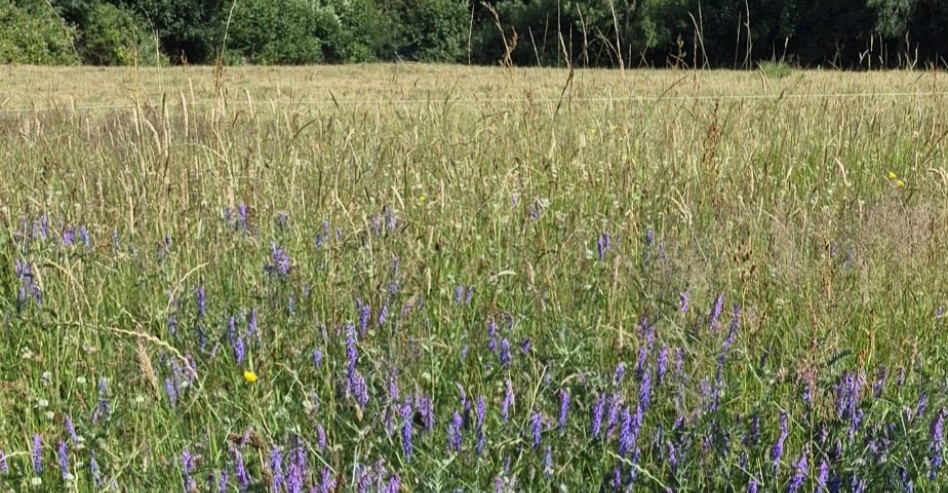
“Where we have diverse leys with herbs and clovers, the grass has come back quicker and stronger than in the areas which are more monocultural. Herbs and clovers, probably due to their deeper-rooting properties, have really come into their own this summer for their ability to survive drought.
“Our hedgerows and trees have been vital in providing shelter for our cows and sheep during these heatwaves. In some areas where we have trees and hedges, the grass looks greener, perhaps because it was shaded and less moisture evaporated. However, in other places, it looks like the trees have sucked all the moisture out of the soil and the grass is browner. Despite that, I’m still looking to plant more trees in fields next year because they have been invaluable for animal health.
“Overall, I would say our nature-friendly farming system does have bounce-back resilience. The soil has really come back to life with the rain; it was like it was just waiting to be woken up again. My focus for next year is now going to be on water management; I’m looking for grants for ponds and a couple of wells.”
Debbie Wilkins - Gloucestershire, England
“It’s still very dry here, but comparatively speaking our permanent pasture, where we’ve built up higher levels of organic matter in the soil, is bouncing back quite nicely. On the other hand, our ex-arable fields where the soil isn’t in as good a condition, aren't recovering in the same way.
“For me there’s no doubt the fields where we’ve been practising nature-friendly farming for longer are doing better than the ones that are still in transition.”
Rhodri Lloyd-Williams - Ceredigion, Wales
“On our farm, everything has recovered quite quickly following a fair amount of rain. We’ve always had grass in front of the animals this summer, and I’m hoping we can have a good run in the winter months without having to buy in a lot of expensive feed.
“Where our herbal leys have deeper-rooting plants like plantain, chicory, timothy and cocksfoot, they have stayed green and kept going all the way through the summer’s drought. After this summer, I’m not against getting more diversity into our swards, as the more of that we have the more resilient we’re going to be to extreme weather.
“Our hedgerows have helped too. I’ve definitely noticed that our swards are longer and greener for the three or four metres of the field that are nearest to the hedges. People have said they can’t believe how much grass growth there is or that we haven’t reseeded some of our fields. We’ve also had recognition of the importance of the trees and hedgerows in protecting the animals from heat stress.”
Matt Elphick - Surrey, England
“We’ve had some pretty extreme conditions here. We had a long period with basically no rainfall and the farm was looking quite dusty and barren. However, the grass did green up quite quickly when the rain finally arrived. Recovery has been quicker than we thought it might have been.
“However, we are still feeding our cows as much haylage as during the drought, as we haven’t been able to maintain enough grass in front of them to stop supplementing feeding. I’ve also set aside some of our acreage for a few weeks to do herbal ley overseeding, as I want that extra resilience that comes from the deeper-rooting plants, alongside the benefits of a more diverse diet for our cows.
“It’s inevitable we will get more of these drought periods going forward, so I’m working on keeping the pastures greener and more grazeable for longer. I’m also looking at using a spray-on seaweed fertiliser in spring, so the pasture gets an extra boost to start grass growth when there’s still moisture in the soil.”
Research by the AHDB has shown that deeper-rooting, multi-species swards can boost drought resilience because the plants reach deeper into the soil to find moisture and nutrients. Legumes can also fix nitrogen, reducing reliance on chemical fertilisers and further boosting soil organic matter.
Despite these encouraging signs, livestock farming overall still faces major challenges from climate change and extreme weather. Analysis by the Energy and Climate Intelligence Unit (ECIU) thinktank shows grass growth for 2026 is expected to be very similar to that of 2025, with both years between 10% and 15% down on the 2019-24 average.