Flowing on from this, there are multiple statements - many directly informed by NFFN members - that make clear the Government now recognises the central importance of working with nature and is committed to supporting a large-scale transition to low-input, nature-friendly systems:
“...the most resilient farms are profitable precisely because they work with the environment, not against it. These approaches are not at odds with food security but are increasingly central to it. Lower input systems can maintain or increase productivity by improving soil health, increasing nutrient efficiency and reducing exposure to volatile input costs. These systems can additionally build resilience to drought, flooding, disease, and other extreme weather and can accelerate nature’s recovery.” (p.9).
This is a huge win for the network and you, its farmer members!
Arguably the second most important thing the Roadmap does is set out a clear direction of travel for how environmental improvements will be incentivised in farming: via a combination of public funding, private investment and increasing regulatory requirements over time. This clarity is vital and long overdue and we’ll come back to what this might look further down.
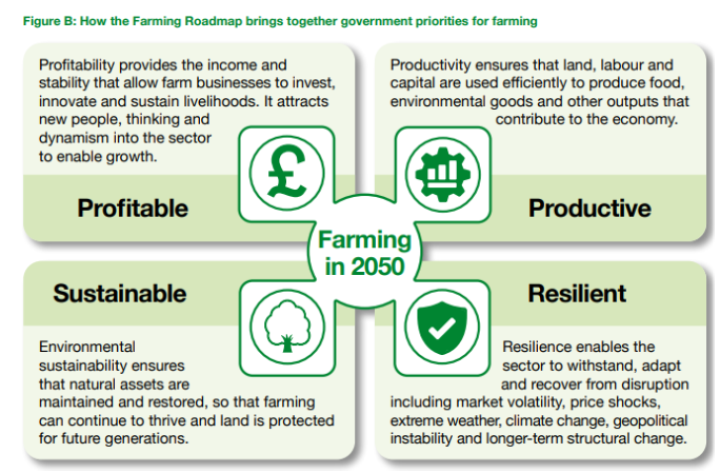
Profitability and productivity
The Roadmap positively states “we want a highly productive food system that recognises nature and farming as fundamentally integrated” and have committed to a range of actions including:
More investment in the Farming Innovation Programme and for farmer-led test and trials through ADOPT grants (Accelerating Development of Practices and Technologies)
Supporting wider adoption of on-farm practices that improve margins, yields and resilience while reducing costs and environmental harms
Investing in improved skills and knowledge across the sector, including through more peer to peer learning between farmers
More broadly, the Roadmap commits to boosting growth in the sector, including through; sector specific growth plans for horticulture and poultry, expected to be developed in earnest over the remainder of 2026; changes to planning policy; driving export growth and; creating better opportunities for UK farmers through public procurement.
There is much to welcome in this section but there is also much to be cautious about. For example, while there are certainly planning issues that need tackling, such as enabling more on-farm water storage more easily, there remain tensions with projected expansion of intensive poultry livestock units (ILU) when we still have not dealt with the negative external impacts of our current ILU infrastructure. Similarly, going for growth for the export market poses risks which need strong safeguards to prevent further intensification taking place as a result. The Roadmap also stops short of committing to a long held ask from the farming sector: that no food is imported that has been produced to lower environmental standards. While the Roadmap does say the Government will consider a range of powers to protect UK producers from unfair competition it starkly highlights that trade deals are the purview of the Department for Business and Trade, not Defra.
Sustainability
This section makes clear that:
“...further action is needed to reduce pollution and emissions, rebuild soil health, recover wildlife, improve resilience to climate risk, and protect the natural assets and healthy livestock populations that farming relies on. This will require a shift towards more soil-focused and low-input practices, clearer expectations, and reform of the systems that govern land use, regulation and service delivery. This transition secures the long-term economic sustainability of farming while supporting the other many benefits of our natural systems.”. (p. 39)
The Roadmap sets out how this essential transition will be driven over time: using regulation, publicly funded policy tools (particularly ELM schemes) and aligned private finance. How this might look over time is best expressed through real world examples:
For example:
Mitigating land management actions, like buffer strips to prevent nutrient runoff, are highlighted as time limited with current ELM payments in future replaced with regulatory requirements.
Conversion actions like catch, cover and companion cropping, currently rewarded through ELM payments, will also be time limited with payments phased out “as they become established in supply-chain requirements and best practice in farming”.
Public good actions which need active management, take place on land that could otherwise be used for food/feed/fibre etc production or are statutorily protected will continue to be publicly funded long term, unless sufficient private finance becomes available and can replace it.
As the Roadmap highlights the importance of stability for the sector for at least the next 3 years (the rest of this parliamentary term) there are unlikely to be major changes before 2030 but the future direction of travel is unambiguous. It is also very reasonable - the private sector must pay its fair share; it is reasonable to expect the farming sector to abide by a fair and effective regulatory baseline, and; it is not a great use of public money to pay for actions that also directly reduce farm costs.
Extremely positively, ELM remains a central plank, evidenced by the 2-stage reopening of a slimmed down SFI26 in June and September and the expansion of Countryside Stewardship Higher Tier (CSHT), announced in July.
Resilience
This section reinforces many of the Roadmap’s commitments under the above themes, while plugging some important gaps, particularly how the role of private finance will be better harnessed and aligned with public investment in a farming transition, including the Government’s role in:
Ensuring access to functioning and fair nature and carbon markets
Growing nature and carbon markets.
Supporting more supply chain investment in the transition
Additionally, it highlights what action will be taken to improve climate adaptation across the sector - vital as our climate shifts and the frequency and intensity of extreme weather events grows, including through more investment in peatlands, trees (and hedgerows) on farm, natural flood management and biosecurity.
More broadly, this section adds more detail to how data use will improve to support better on farm decision making, including on land use; support better enforcement of regulation, such as on water quality and; support aligned private sector investment
So what next?
The Roadmap is broadly a very good document. It sets out the work not just the next three years, but the next couple of decades and at every stage the NFFN will ensure the voices of its members are plugged in.
The steps below are not exhaustive but they are absolutely key for the Government to action if we are to have the farming transition we need: one with nature and climate resilience firmly at its heart.
In the very short term:
The new Defra Ministerial team must publicly and swiftly recommit to the Roadmap to give the sector confidence to plan and invest
Defra should produce an accessible, farmer-friendly timeline of the Roadmap, including all key dates/windows over up to 2029 (the Roadmap timeline is comprehensive but it’s written for policy wonks, not farmers…)
Defra should keep communicating regularly - the uptick in updates from Defra, and its willingness to meet farmer groups, is definitely helping to build trust across a bruised community.
In the short to medium term:
Be consistent and deliver what has been promised! Many farmers are still reeling from decisions taken by the current government, including the hard pause to SFI last year. It is vital Defra delivers what it says it will, including many more CSHT agreements, expedited Landscape Recovery rollout and more ambition in SFI from 2027, including the actions available and how it is targeted on the ground (e..g through Local Nature Recovery Strategies).
Defra needs to expand representation in the new Farming and Food Oversight Board, an initiative directly aimed at driving productivity, sector growth and supply chain fairness but whose current membership is dominated by ‘business as usual’ industry interests.
Develop an equivalent vision for the languishing Food Strategy, and then the same level of urgency so that our food system supports nature friendly farming from farm to fork.
In the longer term: