
Farmer Stories

Chris Dobbs: Building a one-acre organic market garden in Northern Ireland

Northern Ireland
Case Study
fruit and vegetables
food system
Integrated Pest Management
Market garden
soil health

Small-scale fruit and veg growing remains relatively unusual in Northern Ireland - but NFFN grower Chris Dobbs explains why he believes in it.

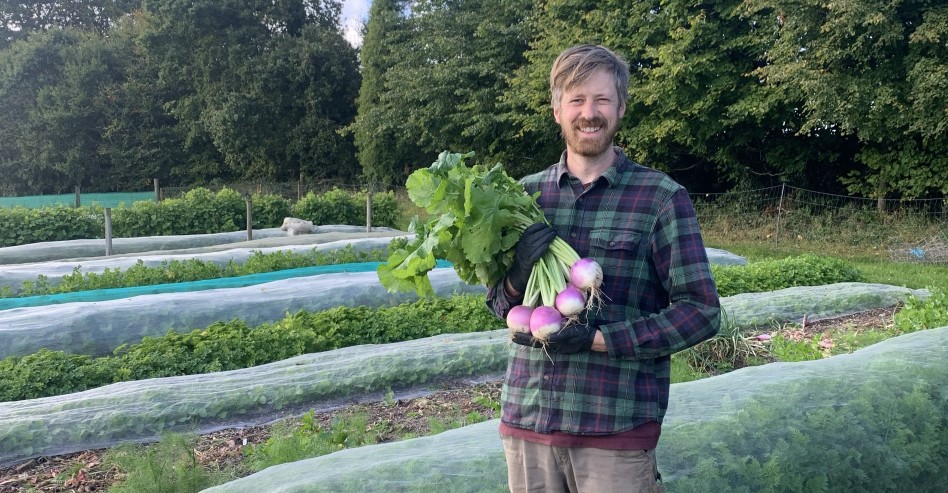
Just outside the town of Carrickfergus in County Antrim lies Chris’ Market Garden, a one-acre operation producing vegetables and salad crops to organic principles. This type of food production remains something of an outlier within Northern Irish agriculture, but the driving force behind it, NFFN member Chris Dobbs, is a passionate advocate for making sure that does not remain the case.

Chris grew up around his uncle’s livestock farm (where he now rents the land for his market garden), but his route into growing was a circuitous one. His childhood coincided with a financially challenging time for farming, and he was encouraged to pursue a career elsewhere. He began studying architecture in Newcastle before moving to London to work in IT. After eight years of office life, he found himself longing to work outdoors, so he spent six months as a gardener before moving to New Zealand to work in a vineyard.

Life then took him to Spain, where he worked on regenerative and organic farms, while also continuing to develop his vegetable-growing skills in North East England. He eventually returned home to Northern Ireland and established Chris’ Market Garden in 2021.

Chris quickly recognised that a market garden offered realistic start-up costs while allowing him to carve out a niche. “Depending on your circumstances, you can start a market garden for under £50,000,” Chris says. “Livestock farming is much more common in Northern Ireland but if you wanted to buy a suckler herd and then factor in the land, infrastructure, machinery and sheds, you could be looking at a serious investment.

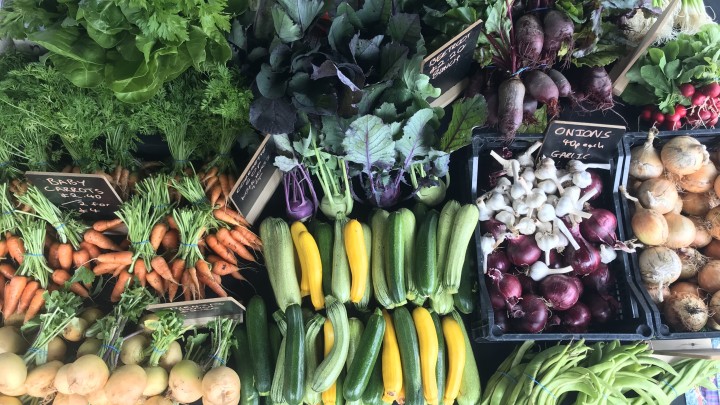
“There’s also not much attention on horticulture in Northern Ireland. Anything grown here tends to be staples: potatoes, onions, leeks and so on. There really isn’t much growing of salad, celeriac, fennel, pak choi and some of the other things I grow. At a small scale, you have to find the right crops to be profitable. There’s no point trying to grow carrots at this scale when they’re sometimes 10p for a bag at the supermarket, but there may be a niche for baby carrots or a particular heritage variety that you can sell at the right price point. Everything I grow has to add value.”
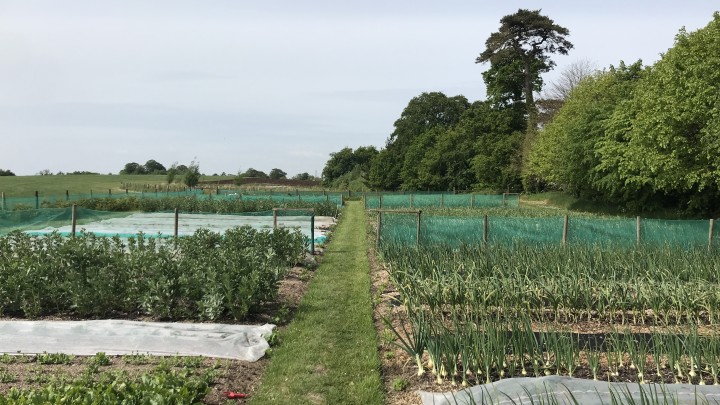
As is common in market gardens, Chris’ growing area is laid out in fixed beds 75cm wide with 45cm paths between them. The beds are also raised above the pathways to improve drainage on his clay soil. Chris started in 2021 with 50 beds and now has 150. Initially he created 10m long beds, but as the business has grown he has extended them to 30m in length.

Having so many beds allows for a detailed crop plan, which makes a wide variety of produce available over a long season. Each bed is worked intensively and may see three different crops in a growing year. A bed may start with an early spring crop, such as salad leaves or baby turnips, followed by a main crop such as cabbage. In the autumn, an overwintering crop such as garlic or onions may be planted, or a cover crop sown for the winter.

“It’s just like any kind of farming: prolonged exposure of bare soil, particularly in winter, is not good,” Chris says.  “It’s a key principle that the beds are never empty. If I harvest a crop in winter, I will leave the debris on the ground. Otherwise, anything that is harvested up to the end of September will be followed by a cover crop. It protects the soil, holds nutrients and improves drainage and soil quality.”

Another advantage of having many individual beds is that it allows for succession crops. “I will sow baby carrots for bunches every two weeks beginning in February, so I know that I will have new crops of carrots coming through two weeks apart,” he says. “In summer I will try to have two beds of salad leaves, two of lettuce and one of rocket or another similar crop ready to harvest at any time.  It’s a very productive use of a small area.”

It's just like any kind of farming: prolonged exposure of bare soil, particularly in winter, is not good.

Chris Dobbs

Chris also uses elements of integrated pest management (IPM). The beds are surrounded by a species-rich mix of annuals and perennials. Some are sacrificial and draw slugs and caterpillars away from the vegetables, while others, like marigolds, give off a scent which confuses insects looking for vegetable plants such as carrots. He also grows plants like Queen Anne’s Lace and Achillea, which attract predatory insects such as ladybirds and parasitic wasps.

Growing to organic principles means Chris uses no chemical pesticides. The one pest control technique he uses regularly, and which is permitted under organic regulations, is a bacterium called Bacillus thuringiensis. “It’s actually quite gruesome, you spray the bacteria on the leaves and it reproduces inside the caterpillars so their digestive system gets blocked up, a kind of terminal indigestion,” Chris says. Netting is also used to protect crops like turnips, carrots and cabbages, as there are currently no nature-based solutions to combat the root fly that attacks them.

Organic principles also mean artificial fertiliser is forbidden, so Chris uses a compost system which takes animal manure produced on local farms and woodchip made from small branches or brash blown down by the wind and transforms it into a mulch that can be spread on the rows. Machinery use is restricted to very shallow rotovation at the soil surface to prepare the beds for planting.

“I really don’t want to break up the soil further down, especially as we’re on quite heavy clay soil which wouldn’t respond well to being worked with machines,” Chris says.  “We’ve got a really healthy earthworm population and they’re breaking down organic matter and improving the drainage and aeration of the soil. Heavy cultivation would undo their good work. We’re also building up organic matter with the cover crops.”

We've got a really healthy earthworm population and they're breaking down organic matter and improving the drainage and aeration of the soil. Heavy cultivation would undo their good work.

Chris Dobbs

According to Chris, market gardening gives him considerable flexibility in choosing and experimenting with what to grow. “The most important thing is to buy good-quality organic seed,” he says. “After that, trial and error is important. If I plant one 10-metre row with a type of beetroot and it doesn’t work in our soil or climate, it’s not a big loss. I can also experiment with timing, because I can quickly re-sow a row if something goes in too early and doesn’t work out.”

Chris supplies a number of shops and wholesalers, including Carrick Community Greengrocers, a co-operative that was founded as part of efforts to revive the local high street.  However, the main outlet for his veg is a box scheme running throughout the summer months, with a final box of remaining produce put together at the end of the year. In 2025 he delivered between 20 and 30 boxes weekly, and is hoping to increase this to 60.

“At this scale, veg boxes are the way to go,” Chris says. “I know exactly what I need to harvest and there are no unsold items, so very little waste. There are also quite a few platforms you can use to set up, which makes it quite easy to organise.”

Most of Chris’ boxes are delivered within a 10-mile radius of the farm, and his platform also enables customers to buy from several other local, independent businesses. He is keen to see growth in this kind of grassroots food system. “This kind of growing reduces food miles and emissions, which is important because in Northern Ireland we export a lot of meat and dairy products. It’s important to grow more of what we eat here and regain a measure of food sovereignty for fruit and veg.”

As well as extending the reach of his veg box scheme, Chris is looking into protected horticulture such as polytunnels to increase the length of his growing season.  “There’s no reason why we can’t grow things like salad leaves for most of the year,” he says. He also has ambitions to increase the size of his cropping area.

As a member of the NFFN NI steering group, Chris is keen to help shape a positive future for market gardens and veg growing in general. “In living memory, every farm in Northern Ireland would have had an acre of veg that fed the farmhouse and the local community,” he says. “We’re at a point where there are only a few growers left, and even some of the larger ones are facing difficulties.

"However, the appeal of local and sustainably produced food is increasing. We need more small and medium-sized growers and an environment that gives them the ability to run a successful business that provides a direct income. That’s vital for a healthy and sustainable local food economy.”

Cookie consent

We use cookies on this website to improve your experience, provide social media features, and analyse our traffic. By clicking Accept All, you agree to the use of cookies as outlined in our Cookie & Privacy Policy. You can manage your cookie preferences at any time by clicking Cookie Settings.