
Farmer Stories

Ben Andrews - Building resilience through veg on a Herefordshire mixed farm

England
Case Study
Cattle
climate change
Crops
Diversification
flood management
horticulture
IPM
Mixed

A partnership with a national veg box scheme has helped this organic tenant farmer spread risk and improve returns.


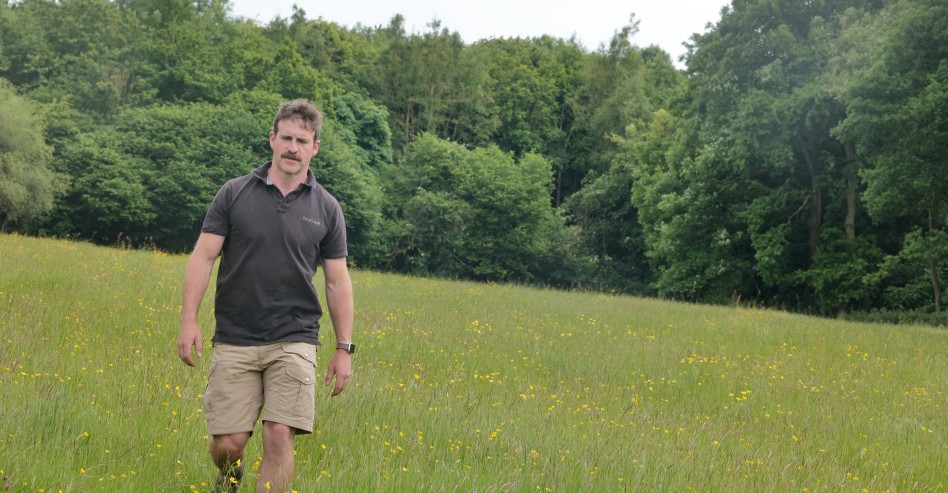
Broadward Hall Farm occupies 450 acres of a Herefordshire river valley on the outskirts of Leominster, along with a further 150 acres of upland about 20 minutes away. Ben Andrews is the fourth generation of his family to farm there as tenants and is now responsible for guiding the next stage of this mixed operation in a more nature-friendly direction.

Like many people brought up in rural farming families, Ben went through a teenage phase of wanting to escape, only to discover the grass wasn’t necessarily greener elsewhere. “I think a lot of kids want to rebel against what they’ve been brought up with at some point,” he says. “I wanted to run away to the city and make my fortune, but after 18 months of working in London, I knew I wasn’t a city boy. It just wasn’t for me.”

Around 150 acres of the lowland farm are permanent pasture. Together with the land on the Herefordshire Plateau, this allows the farm to finish around 100 Angus beef stores each year. The remaining 300 acres in the river valley are dedicated to arable crops and vegetables.

A major turning point came about 25 years ago, when Ben’s dad, Colin, decided to become organic. “Before that, we were fairly intensive potato growers, running a high-input, high-yield system,” Ben says. “My dad took us organic when there were good financial incentives to do so, and it suited us as a mixed farm with really fertile soil where you could grow almost anything.”
Going organic meant removing almost all synthetic and chemical inputs from Broadward Hall Farm.  Soil fertility is now built and maintained through a mixture of herbal leys, cattle manure and biostimulants such as seaweed and molasses. In 2025 the farm also experimented with ammonium nitrate pellets derived from sugar beet, which have proved particularly effective for brassicas, but Ben says there is no real substitute for nature’s own methods when it comes to building good soil structure. 

The farm does follow a rigid crop rotation, but it never grows the same crop in the same field two years running. For brassicas (cabbages, broccoli and kale) there is a minimum four-year break between crops, while potatoes have a five-year rest period.

“Planting into good soil is better than anything else you can do,” Ben says. “When we put crops into ground that’s been through a decent rotation and had a proper rest, with a herbal ley in there, the performance of those crops is always leagues ahead.”

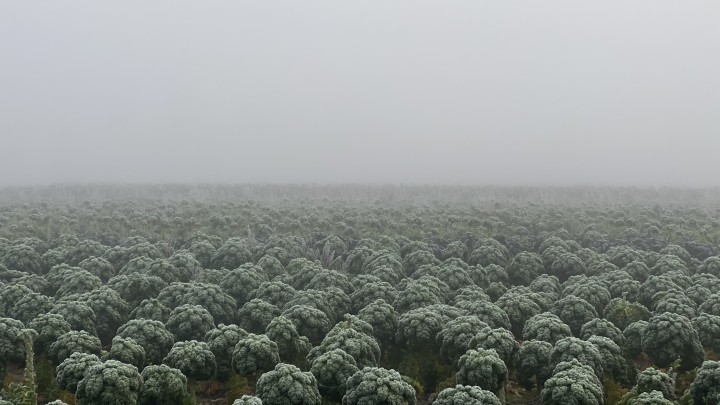
Vegetables now cover around 120 acres, with half of that area given over to potatoes. The remainder is split between broccoli and kale (25 acres each), lettuce (10 acres) and cabbage (between three and four acres). Most of the produce goes to the box scheme Abel & Cole, although broccoli and potatoes are also grown under contract for buyers including supermarkets, and the farm supplies a number of organic wholesalers.

Planting into good soil is better than anything else you can do. When we put crops into ground that’s been through a decent rotation and had a proper rest, with a herbal ley in there, the performance of those crops is always leagues ahead.

Ben Andrews

Ben says the move into vegetable growing was largely a response to going organic. “The box schemes and wholesalers tend to work with farms of around our size. It all started when someone asked my dad if he wanted to grow broccoli. There was quite a large distributor locally, so it just went from there.”

Deciding which vegetables to grow has involved plenty of trial and error. “We’ve always been happy to change course and have tried lots of varieties,” Ben says. “We did carrots for a while but our soil’s a bit heavy, so if we were harvesting in damp conditions it just turned into a mudbath.”

Agri-environment schemes have provided additional income streams, with Broadward Hall Farm entering a number of mid- and higher-tier stewardship schemes. The wild bird seed mix option also sparked an unexpected commercial opportunity, as Ben noticed that sunflowers were growing really well. After a conversation with a friend who grows the distinctive golden blooms for supermarkets, Ben decided to dedicate a couple of acres to sunflowers to strengthen the bottom line. 

The livestock side of the farm has changed too. In the past, Broadward Hall ran a dairy operation on rented land about 10 miles away, but a combination of losing its contract during a crashing milk market and the realisation that the high-input system didn’t fit with their nature-friendly approach led to the herd being dispersed. 

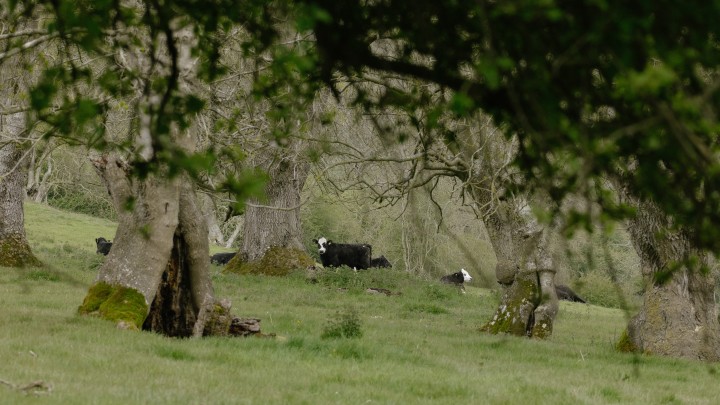
Today, the farm’s organic Angus stores graze the river meadows in spring before moving up to the plateau for summer, where they are rotated around fields every couple of days. The cattle are housed from around November to March for the winter months. 

Oats are grown both for milling and winter livestock feed, while Ben has also introduced spring beans as a home-grown protein alternative to soya for environmentally-conscious farms. In addition, he’s trialling some heritage grains, which he hopes will prove a good fit. “Even as an organic farm we’re a bit small for commodity crop production, so we need to find ways to add extra value to what we produce,” he says. “Heritage grains are less intensively bred, so they tend to perform better in lower-input systems than modern varieties, which often need lots of nitrogen.”

Ben believes diversity is key on a mixed farm like his, providing a spread of risk if problems arise. “As a tenant I still have to pay the rent, so I can’t afford large-scale crop failures,” he says. Keeping the business’s eggs in multiple baskets also helps as climate change makes weather patterns increasingly volatile. “Every year now seems to throw up a new environmental challenge.”

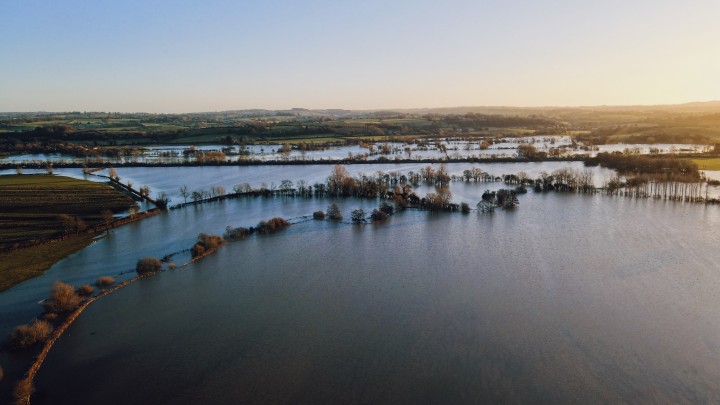
With the River Arrow running through the farm, flooding has become a particularly pressing issue. “We see flooding five feet deep in some fields, and there can now be standing water there from November to March,” he says. “The floods are getting more frequent, higher and hanging around for longer. Some of those fields are once where, 15 or 20 years ago, we would have grown broccoli or potatoes, but it’s just not worth the risk of planting there anymore. There’s also the danger of your topsoil running off into the river, which is just self-sabotage.”

To help address the problem, Ben is one of 50 farmers, with a combined 5,000 hectares of land, involved in an ambitious Landscape Recovery scheme bid. If successful, this will transform the river meadows most affected by flooding into a mosaic of habitats and functional floodplain, including scrapes for wading birds and plant species that could still be used for grazing or hay.

Ben’s approach to farming draws on his family’s long history in agriculture, blending vintage kit with modern technology. “One of our most-used bits of equipment is a steerage hoe my grandfather bought, and it was probably second-hand even then,” he says. “You sit on the back of the tractor moving this handle from side to side and it weeds between the rows of vegetables. But then we’ve also got this GPS autosteer, which means we use space far more efficiently. I’ll admit I’m dreadful at driving a tractor in a straight line, so I don’t want to be reluctant to embrace technology that can help.”

As Ben prepares to take over the farm from his dad, he has been reflecting on his own journey into nature-friendly farming. “I think my dad and I both felt that going organic wasn’t a huge change; it was conventional farming with synthetic inputs replaced by organic-approved ones,” he says. “It wasn’t until I went to events like Groundswell and the Oxford Real Farming Conference, met NFFN farmers and talked to people on social media that I really understood farming’s environmental impact - and how I needed to see our farm as an ecosystem.”

My dad and I both felt that going organic wasn't a huge change; it was conventional farming with synthetic inputs replaced by organic-approved ones. It wasn’t until I went to events, met NFFN farmers and talked to people on social media that I really understood how I needed to see our farm as an ecosystem.

Ben Andrews

Ben’s adoption of integrated pest management (IPM) is where that shift in emphasis is most clearly seen. “It’s eye-opening to be out in the fields planting or picking crops and actually seeing predatory insects like ladybirds and hoverflies attacking the pests,” he says. While this does occasionally mean veg box customers pointing out aphids on their lettuces, Ben now knows from experience that within a couple of weeks the problem will have resolved itself. “It’s about having faith in nature,” he says.

With both financial and environmental pressures intensifying, Ben remains committed to his nature-friendly approach, especially given the wildly fluctuating price of artificial inputs such as fertiliser. “We’re never going to be the sort of farm that rakes in cash and makes huge profits, but I’d much rather be stable and resilient.”

Cookie consent

We use cookies on this website to improve your experience, provide social media features, and analyse our traffic. By clicking Accept All, you agree to the use of cookies as outlined in our Cookie & Privacy Policy. You can manage your cookie preferences at any time by clicking Cookie Settings.