
This event is aimed at active farmers and advisors
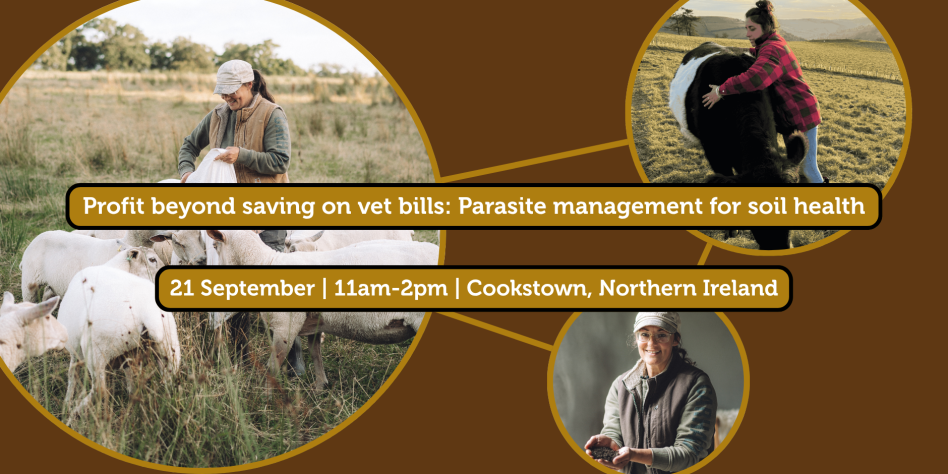
What happens beneath our feet when we treat our livestock?
Claire Whittle is a vet and nature-friendly cattle farmer from Wales with a passion for soil health and the remarkable living systems that make healthy pasture possible. Dung beetles, earthworms, bacteria and fungi all play vital roles in nutrient cycling, soil structure and productive grassland.
Yet, while animal health rightly comes first, we don't always consider what happens to these organisms after livestock medicines pass through animals and onto the land.
How might veterinary medicines affect soil life, and what can farmers do to minimise those impacts while maintaining good animal health?
Claire will explore the science behind livestock medicines, soil biology and dung beetles, alongside practical approaches to parasite management.
We'll then head out onto Bronagh O'Kane's mixed livestock farm, where Bronagh – a self-confessed "soil nerd" – will share her experience and approach to building healthy soils.
Get ready for a dung beetle safari, with gloves provided so everyone can get involved and discover the life in the dung pats.
Lunch will be provided between the indoor session and farm walk, with plenty of opportunity for informal chats, questions and sharing ideas and experiences.
Come along and discover the hidden life working beneath your livestock's feet.
Speakers
Claire Whittle is a cattle farmer and vet. Claire offers a different way of thinking and understanding your farm as an ecosystem and the huge benefits that diversity and nature can provide for livestock health. As a practising clinical farm vet for the past 11 years, Claire has a deep understanding and knowledge of different livestock systems. Working as far as possible with the most up-to-date research, Claire is also on the NFFN Wales Steering Group.
Bronagh O'Kane
Having returned to NI in 2020 after 12 years in the RAF as an aircraft mechanic and 7 years co-running a textile design business, I fell in love with the family farm and began the journey of taking it on.
The farm has challenging silty clay soils with zero sand content, so improving soil health and resilience has become something of an obsession. Historically, it was intensively stocked with continental breeds, ryegrass and synthetic inputs. I began transitioning to more traditional breeds and removed all synthetic inputs, introducing adaptive multi-paddock grazing with longer rest and recovery periods to build soil structure, encourage diverse swards and develop deeper root systems. We are also gradually introducing more diverse reseeds and wildflower meadows.
I started a worm farm to produce vermicast, which is used as a biological soil amendment and seed dressing to improve soil biology, particularly soil fungi.